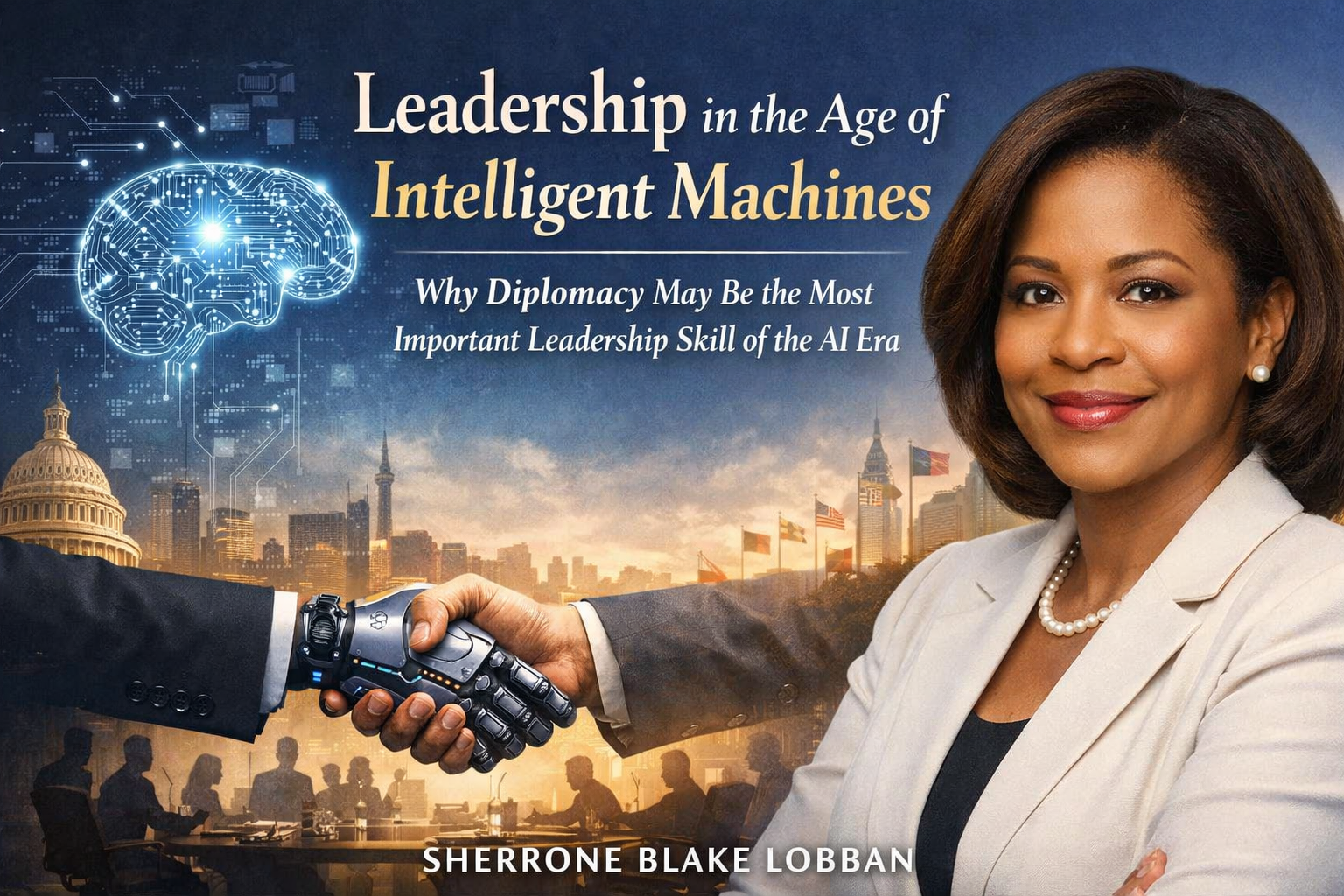
Leadership in the Age of Intelligent Machines: Why Diplomacy May Be the Most Important Leadership Skill of the AI Era

AI and Diplomatic Thinking Leadership
Leadership in the Age of Intelligent Machines

Why Diplomacy May Be the Most Important Leadership Skill of the AI Era

Artificial intelligence is transforming decision-making across governments, corporations, and institutions at a pace few anticipated. Algorithms now assist with economic modelling, strategic planning, risk forecasting, and policy design. What once required teams of analysts can now be produced in seconds.


The Seduction of Algorithmic Authority


One of the most subtle risks of AI adoption is the gradual shift in perceived authority.

When algorithms consistently produce highly structured analyses and predictive models, their outputs can begin to carry an aura of objectivity that feels difficult to challenge. Leaders may begin to justify decisions by referencing “what the model shows” rather than articulating a clear strategic judgment.


This shift may appear harmless. In fact, it can quietly reshape the culture of decision-making. Models offer probabilities and Leadership requires responsibility.


A forecast can suggest a likely outcome, but it cannot decide which risks are worth taking, which values must be protected, or which trade-offs a society or organization is willing to accept. Those decisions belong to leaders.


Diplomatic leadership is particularly valuable here because it recognizes that information and judgment are not the same thing. In diplomacy, data informs negotiation, but it does not replace the human process of weighing interests, anticipating reactions, and managing long-term relationships.

Why Data Alone Cannot Govern Complex Systems

Artificial intelligence excels in environments where patterns are stable and objectives are clearly defined. However, many of the most consequential leadership decisions occur in environments where neither condition holds.

Economic shifts, geopolitical tensions, cultural expectations, and organizational dynamics rarely behave like predictable datasets. They evolve through human interaction.

Diplomats have long understood this reality. Negotiations between nations are rarely determined by data alone. They depend on interpretation, trust-building, strategic signaling, and an awareness of how decisions reverberate across multiple actors over time.

In other words, diplomacy operates in systems of complexity rather than systems of calculation.

As AI becomes embedded in leadership processes, executives and policymakers will increasingly confront situations where algorithmic insight must be balanced against human considerations that cannot easily be quantified:

  • social stability
  • institutional legitimacy
  • long-term trust
  • ethical responsibility

These factors cannot be outsourced to algorithms. They require leaders capable of holding multiple dimensions of a decision simultaneously.

The Quiet Risk of Intellectual Abdication

Perhaps the most concerning development in the AI era is not technological dependence but intellectual disengagement.

When information becomes abundant and instantly accessible, leaders may be tempted to move more quickly through the process of thinking. AI summaries replace deep analysis. Automated insights replace reflection.

Yet the act of leadership has never been primarily about information processing.

It is about judgment under uncertainty.

Diplomatic leadership teaches a discipline that may become increasingly valuable: the ability to pause, interpret context, and consider the human implications of a decision before acting.

In diplomacy, silence is often strategic. Reflection precedes response. Decisions are shaped by an understanding that today’s move may influence relationships years into the future.

This form of thinking stands in stark contrast to the speed-driven logic of many digital systems.

Leaders who maintain this discipline will become increasingly rare — and increasingly valuable.

Reasserting Human Authority in the AI Era

The challenge for modern leaders is not to resist artificial intelligence but to govern its role within decision-making. Three principles can help maintain this balance.

1. Preserve the distinction between insight and judgment

AI can surface patterns, generate options, and test scenarios. These capabilities should enhance strategic thinking, not replace it.

Final decisions must remain anchored in human judgment.

2. Maintain accountability at the leadership level

No algorithm can bear responsibility for the societal, organizational, or ethical consequences of a decision. Leaders must resist the temptation to attribute outcomes to “the system.”

Authority and accountability remain inseparable.

3. Cultivate diplomatic thinking

Diplomatic leadership encourages leaders to look beyond immediate data toward the broader ecosystem of consequences: relationships, perceptions, and long-term stability.

In a world increasingly mediated by algorithms, this perspective becomes indispensable.

Are you ready?.
What can we help you achieve?.

The Leadership Advantage of Diplomatic Thinking

The leaders who will navigate the AI era most effectively may not be those with the most advanced technical tools. They will be those capable of combining technological insight with diplomatic intelligence — the ability to interpret context, manage competing interests, and exercise judgment that accounts for human complexity.

Diplomacy teaches leaders to operate in environments where information is incomplete, actors have conflicting priorities, and decisions must balance short-term gains against long-term consequences. These are precisely the conditions shaping the future of leadership.

Artificial intelligence may dramatically expand our analytical capabilities. But the ultimate test of leadership will remain the same as it has always been: the capacity to make wise decisions on behalf of others when the stakes are high and the outcomes uncertain.

In that sense, the age of artificial intelligence may ultimately reaffirm a very old truth.

Technology may inform leadership, however, wisdom still governs it.

Are you ready?.
What can we help you achieve?.

About the author

Sherrone is a 4x founder. Sherrone is a former diplomat who now helps companies design and implement connected strategies that lead to competitive advantage, increase in revenue while simultaneously contributing to staff improvement and customer satisfaction.

Leave a Reply